Tuesday, April 5, 2022

Armadillos: Warner Park’s Oddest Mammal!


 Armadillos: Warner Park’s Oddest Mammal!


Photos  and Videos by Kim Bailey


With squinty little eyes reminiscent of Winnie the Pooh’s Piglet, leathery ears, and an armored body, the armadillo looks like no other mammal in town. Indeed, it is the only mammal of the Order Xenarthra found in the United States. An identifying characteristic of this order is the presence of rudimentary teeth consisting solely of enamel-less, peg-like molars.

A century ago, you would have probably had to go to Texas to see an armadillo, but a warming climate and lack of predators has allowed this spunky critter to expand its territory. Due to their low metabolic rate and low fat reserves, populations are limited by prolonged cold weather. First documented in Tennessee in 1960, armadillos are now found as far north as southern Nebraska and as far east as North Carolina.

A number of sightings have been reported in Warner Park over the years. My favorite was of a mother and her young (each litter consists of identical quadruplets) near the AlleĆ©.  What could be cuter than 4 tiny “Piglets” snuffling through the leaves?!  The most recent sighting was of a dead adult on the Hill Forest after a week of intense cold. I suspect most sightings are of dead adults, usually along the highway, where they fall victim to traffic.

Armadillos can be relatively easy to observe if you are lucky enough to be downwind. Intent on foraging, they seem oblivious to their surroundings and may even walk right up to you.  It quickly becomes clear that they have extremely poor vision. When alarmed, they stand up on their rear feet and sniff the air for any sign of danger. If a threat is detected, they run for cover, the bands of armor protecting the body from thorns and low- growing brush.

An armadillo runs with surprising speed when it detects danger.

The armadillo will dive into a burrow if one is nearby.  If one is not handy and loose soil is available, it will put its claws to work, excavating a burrow in record time. 


The sharp claws of an armadillo are perfect tools for digging.

Contrary to popular belief, nine-banded armadillos cannot curl into a ball. They have too many bony plates. But if escape is not possible, the armadillo will curl up as best it can to protect its soft, pinkish underbelly.

Armadillos spend most waking hours with their highly- sensitive noses pressed to the ground, pushing up leaf litter in search of insects and other invertebrates.  


Armadillos use their sensitive nose to search for prey.

Those strong claws are adept at digging up tasty prey, which are snatched up by the sticky tongue.   

Arthropods, especially ground beetles and ants, make up the majority of their diet, but armadillos are opportunistic. 


Patent-leather beetles are favorite prey.

They have been known to eat berries, reptiles, amphibians, bird eggs, carrion and even young rabbits.  Many homeowners complain of the holes left behind by a foraging armadillo: it is the price we pay to coexist with this intriguing mammal. 

Armadillo foraging in the Hill Forest

Armadillos are fond of water and are surprisingly good swimmers. They can dog paddle and even float by gulping air and inflating their intestines. They can also hold their breath for up to 6 minutes and sometimes choose to simply walk across the bottom of small streams.

If you’ve seen an armadillo in the park, share your story in the comments below. And if you haven’t, I hope you will be lucky enough to see one of these fascinating mammals for yourself someday!

-Kim Bailey, naturalist


Tuesday, March 22, 2022


The Birds, Bees, and Butterflies Too


 By Melissa Donahue

Naturalist

Spring has arrived!  The weather is warmer.  We are all anxious to get outside, in the woods and in our yards.  Many of us are planning gardens and purchasing plants with the birds, bees, and other insects in mind. But be aware, a plant labeled butterfly, bird, or bee friendly, may not be so.


Farm equipment spraying pesticides 


As a beekeeper I’ve known about the dangers of Neonicotinoids (Neonics) for a while.  Neonics are now the most widely used insecticides in the world.  Used in both agricultural and ornamental plants, neonicotinoids are highly toxic to many insects. The insecticide is applied as a coating on a crop seed or sprayed directly onto the plants after they grow.  If coated on the seeds this coating is water soluble and is taken up and dispersed throughout the plant.  Although meant to target only destructive insects, they affect all insects.  The residual of neonics can stay in the soil and pollute the ground water. Unfortunately, the insecticide has been detected in untreated crops and woody plants.


Honey Bee on Flower

 This poison is systemic and found in the pollen and nectar of plants.  When bees, (honey, solitary, and bumble) visit the flowers of neonic-treated plants, they are negatively affected.  Honeybees may experience problems with flight and navigation, be slower at learning new tasks, and have reduced taste sensitivity.  This effects the overall productivity of the hive.


Beekeepers

Management by humans helps to maintain the population of honeybees  The native bees are not as lucky.


 Bumblebee


 When visiting neonic-treated plants, bumble bees experience reduction in food productions, reduced reproduction rates, lower worker survival rates, reduced colony survival and diminished foraging activity.  Because a Bumblebee Queen’s production is significantly reduced by neonic exposure, there will be fewer colonies established over the following year.


Female  Mining Bee - photo credit: FarmandDairy.com


Some solitary bees can be affected by delayed maturation of larva, reproduction ability and increased  mortality rates due to neonic exposure.


    Purple Martin with Insect - Photo Credit Charlie Curry


Because I was focused on bees, I didn’t take into consideration the full impact of neonicotinoids.  These pesticides affect the entire food chain.  They are not only harmful to insects, but to the birds and other animals that consume these insects.  Studies have revealed these insecticides are harmful to birds and invertebrates even when used at low levels.    


 Male Bluebird – Photo Credit Deb Beasley

According to a study published in Nature the increase in neonicotinoid use led to statistically significant reductions in bird biodiversity between 2008 and 2014 relative to a counterfactual without neonicotinoid use, particularly for grassland and insectivorous birds, with average annual rates of reduction of 4% and 3%, respectively. The corresponding rates are even higher (12% and 5%, respectively) when the dynamic effects of bird population declines on future population growth are considered. Li, Y., Miao, R. & Khanna, M. Neonicotinoids and decline in bird biodiversity in the United States. Nat Sustain 3, 1027–1035 (2020).  This article contains more information.   https://abcbirds.org/neonics#:~:text=As%20our%202013%20report%20revealed,enough%20to%20kill%20a%20songbird


Monarch Butterfly on Thistle

 It’s not just the birds and bees that are at risk because of neonicotinoids. Recent studies have also detected a disturbing downward trend in monarch butterfly populations.  A naturally occurring parasite, Ophryocystis elektroscirrha (OE) has increased in the monarch population. This debilitating pest can shorten the monarch’s life span.  


Tropical Milkweed - Photo Credit - North American Butterfly Association.

Along with climate change, one plant is believed to contribute to this decline.  Tropical milkweed (Asclepias curassavica), a non-native milkweed, is attractive to both butterflies and humans. The Monarchs will land on the leaves of this milkweed and some of the spores from the parasite will fall onto the leaves.     When the spores fall onto the leaves of a native milkweed, the spores die in the winter when the leaves fall off the plant.  Because of climate change this plant can now survive southern winters, the leaves never fall off and the spores survive.  Winter survival of the parasite leads to a larger population of parasites.  This larger population of parasites is responsible for the decline in the monarch population.  More information is contained in this article.

https://monarchjointventure.org/images/uploads/documents/Oe_fact_sheet.pdf


 Butterfly weed is a beautiful native milkweed.

We can turn things around.  Use native plants purchased from a respected nursery.  Buy organic food when you can.  Check the labels when buying flowers and seeds, if they are not labeled, ask if the plants were grown with neonicotinoids.  Support research and local charities, such as Friends of Warner Parks, https://www.warnerparks.org/  that value native plants, the birds, and pollinators.   Making these changes will keep the birds, bees and butterflies around for a long time.


Tuesday, February 22, 2022

 Who Knew Nature Could Be So Fun!

"I like how it feels" - McCabe CC

“If I keep this dirt in the jar for a long, long, long time, what will happen?” 

“Where will these ants find their food?”

“Ugh, stink bugs! But they’re so interesting to watch.”

“I love the colors of this bug.”

“Will it bite me?”             “Oh, it tickles!”

Apologies, dear reader, but there are hardly any pictures to go with my story. We’re always just too busy. Sometimes we take a photograph of a specimen to be able to look up information later, but you’ve seen plenty of bug pics in your life. No need to show those here.

Instead, imagine hearing the excitement in the words of the kids as I have shared above. Try to visualize them as they saunter slowly over the grounds of the community center parks carefully looking for living things. Then, suddenly, the race is on as someone shouts, “Come see what we found!”


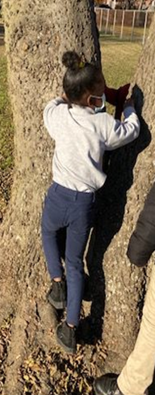
Kids at Madison Park CC explore leaves and trees.


Because, dear reader, this is what Naturalists do. 

And this is my marvelous world as I visit Metro Parks Community Centers in the role of the Urban Naturalist representing Warner Park Nature Center. I’m the Nature Lady, Ms. Betty, or just the person they hit on the arm to ask a question. 

My mandate is to get kids outside to discover the natural world – their natural world. This is the goal. We want children to understand that they are one with nature. Nature is not out there. Nature is part of us, and we are part of Nature. The Sun’s energy cycles through microbes and plants and animals and us. It’s our own back yard, in the bark of the tree, and in the crack in the sidewalk.

Discovery and sharing are important aspects of what we do together. Our club is called Nature Detectives and we look for clues to learn the answers to our questions. We notice. We wonder. We observe. We always look for evidence. We learn scientific terms and do not assign human emotions to the animal specimens.

But we do establish relationships with creatures and plants as we compare our basic needs with theirs and learn how very clever and unique each species is in providing water, food, shelter, and safety in their habitat. 

Similarities of need help children establish an emotional relationship with the natural world. So, then you’ll hear, “Don’t step on that ant. The colony is depending on it for food. Don’t you know they have to all work together?” 

A small, small world unites us. My hope is that these “detectives” will protect our Mother Earth.

Betty Krogman

Urban Naturalist

Warner Park Nature Center

February 2022


Tuesday, February 8, 2022

          Name That Winter Sparrow

         Melissa Donahue - Naturalist


Photo by Charlie Curry 

When hiking through a field in the winter have you noticed small birds flitting around?  Do you peer through the brambles to try to figure out what the little brown bird might be?  Often this little brown bird is a sparrow, and sparrows can be hard to identify.  Winter is the best time to see sparrows in Middle Tennessee.  Often found in fields, along the forest edge or sometimes at feeders, we can spot both year-round residents and migrants.  Through close observation you will begin to notice the differences in these little brown birds as they search for seeds.


 Field Sparrow – Photo by Graham Gerdeman

 The ranks of these small year-round sparrows swell in the winter as short-term migrants join year-round residents. The pink bill and legs are an identifying feature of Field Sparrows.  For further identification look for a gray face, light eye ring, reddish cap, and rusty brown streak behind the eye. The male can be heard singing from late winter to mid-June.  Listen for this song as you drive into the Warner Park Nature Center Parking lot.

  https://www.allaboutbirds.org/guide/Field_Sparrow/sounds


 Song Sparrow – Photo by Graham Gerdeman 

   Behavior helps with identification of this bird.  Watch for it feeding on the ground with a cocked tail and scratching with both feet to expose food.  The Song Sparrow is a winter visitor to parts of Tennessee, year-round in the East.  This sparrow is brown with dark streaks on its back and the breast is white with dark streaking that forms a dark central spot.  The song sparrow’s song lasts for 2 – 4 seconds and can vary greatly from one place to another. 


Fox Sparrow Photo by Graham Gerdeman

This large Fox Sparrow is a regular but uncommon winter resident.  Seen at feeders as well as foraging in the leaf litter this sparrow is easily recognized by its reddish color.  The sparrow is heavily steaked on the chest with a reddish tail.  On warm winter days this bird sings from a camouflaged post, so you will hear the song before you see the bird. 

https://www.allaboutbirds.org/guide/Fox_Sparrow/sounds


White Crowned Sparrow Photo by Graham Gerdeman

This White-crowned Sparrow, another winter visitor that may be seen on the ground below feeders, in grasslands, and in fields.  This bird has an eye-catching crown on the head with two broad black stripes separated by a broad white stripe.  A sparrow with little streaking, it has two white wing-bars and a dark brown tail.   As spring arrives listen for this sweet whistle.

   https://www.allaboutbirds.org/guide/White-crowned_Sparrow/sounds


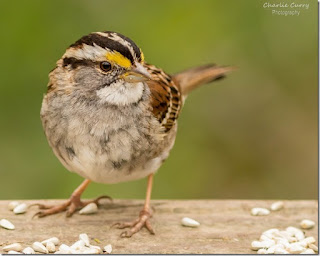
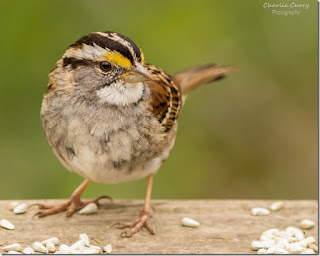
                                       White Throated Sparrow – Photo by Charlie Curry

Each October I listen for this call, a distinct Oh Sweet Canada Canada Canada telling me this winter migrant, the White-throated Sparrow, has returned.  https://www.allaboutbirds.org/guide/White-throated_Sparrow/sounds   Arriving in flocks these are the most abundant of Tennessee's wintering sparrows.  Often seen at feeders, this songbird also prefers shrubby edges in areas that facilitate ground foraging for seed.  Look for a sparrow that is brown above and gray below with white throat.  There are two morphs for head coloration, a coloration white crown and a coloration with a tan crown.


Photo by Graham Gerdeman

Want to learn to more about these sparrows and how to better identify them?  Sign up for the Identifying Winter Sparrows Workshop happening this Friday and Saturday! During this workshop, BIRD Program Volunteer Graham Gerdeman, will teach you where to find and how to identify winter sparrows and other winter grassland birds. The workshop will focus on key characteristics, vocalizations, habitat, and behavior that aid in identification. Beginning with a Friday-evening webinar followed by a morning hike you will search the fields and edges of Warner Parks for these often shy, but impressive birds.          

email wpnc@nashville.gov or call 615-862-8555  to register.

Presenters: Graham Gerdeman and BIRD Program Staff

Wednesday, January 26, 2022

How to Plant a Tree


Shared by Daniel Charlton, Warner Parks Tree Trust Program Coordinator


It's tree planting season here in Warner Parks!  Fall and winter are a great times for planting.  The trees are dormant, which helps them cope with the shock of being transplanted and gives them plenty of time to establish their roots before the hot growing season.  Here in the Park, we're planting a variety of sizes, from tiny bareroot seedlings to small and mid-size container-grown trees, up to large balled and burlap wrapped trees.  This post will walk you through the process of planting a container-grown tree, the type of tree you're most likely to plant around your home or property, and give you a few tips to help ensure your tree stays healthy as it grows.

12 balled and burlapped trees that were generously donated to Warner Parks by the Root Nashville campaign


When deciding where to plant your tree, look up.  Some trees prefer to grow in full or partial shade; others won’t grow in anything less than full sun.  Check the requirements for the species you’re planting.  Watch for any obstacles the tree may grow into as it matures.  This guide from the Nashville Electric Service can help you decide how far away from power lines to plant.


You can use the handle of whatever tool you’re digging with to measure the width of the tree’s root ball.  You don’t need to be exact; you want to dig the hole about twice as wide as the root ball and just the depth of the roots.  Dig the hole shallow to start with.  It’s easy to keep digging deeper if you need to, but if you dig the hole too deep and then fill it back in, the tree usually settles lower after a few rains and will end up being planted too deep.


At the base of the tree, you’ll find what’s called the root flare.  Picture a child’s drawing of a tree; it doesn’t go straight into the ground like a pole; it flares out at the base.  

You may need to scrape some dirt away from the trunk to find the root flare.  Make sure this root flare is planted at or slightly above the level of the surrounding soil; burying it can cause the trunk to rot. 


Dig the hole deepest in the center, with sides sloping inwards.  Remove any rocks or roots from the hole and break up any large clumps of dirt as you dig.  You’ll add this dirt back into the hole later, and it’s easier for the roots to grow through looser soil.  


Gently remove the tree from its container and look at the roots.  If you see mostly dirt with a few roots here and there, the tree is probably ready to plant.  If you see a thick mass of roots growing in a circle all around the root ball, you’ll need to break them up.  If the roots are too thick to break up with your bare hands, a shovel or some pruning shears should do the trick.

This rootbound tree needs to have its roots broken up before planting.

Cut the roots vertically all around the root ball and try to direct them outwards.  This helps develop a wide and healthy root system and keeps the tree from choking itself as it grows larger. A lot of people try to avoid this step for fear of hurting the tree, but the greater danger is being too gentle, which can kill the tree a few years down the road.  By being rough with it now, you’re saving its life.  Try to keep the soil around the root ball in place as you break up the roots and be ready to get the tree in the ground immediately after this step.


Once your hole is the right size and the roots are broken up, place the tree in the hole.  Positioning is up to you:  if you’re more practical, arrange it so that its branches will catch plenty of sunlight; if you’re more creative, position its most attractive side toward where you’ll see it most often.  Check that the branches are splayed out as much as possible and not tangled up in each other.  


Make sure the tree is standing up straight!  It’s surprisingly easy to forget this step.  Walk all the way around the tree.  It might look straight from where you were standing but have an obvious lean from another side, and that’s a lot harder to fix once you’ve filled the hole in.  This is easiest with two people; one person can hold the tree steady while the other person checks that the tree is straight and then fills in the hole.


Add the dirt back to the hole a little at a time, pressing it gently in as you go.  This is a balancing act; if the soil is too loose, the tree can start to lean or fall over, but if it’s too compressed, the roots have difficulty growing.  A firm touch is enough; stomping is excessive.

Patting the soil gently into place


If you didn’t compress the soil too tightly, you should have a good amount left over.  Use this to create a dirt ring 5-6 inches wide around the base of the tree.  It will look like a donut on the ground around the tree.  This helps catch water and direct it inwards towards the tree’s roots.  Cover this dirt donut and the area inside it with 2-4 inches of mulch.  This helps retain the water they need, protects them from extremes of heat and cold, and reduces competition from weeds.  Beware of over-mulching, though.  You’re probably used to seeing “mulch volcanoes,” big hill-shaped mounds of mulch piled all the way up to the trunk of the tree.  These can cause lots of problems for trees, holding too much moisture and making the tree more susceptible to insects, diseases, and rot.  Make donuts, not volcanoes!

A ring of mulch covers the ring of dirt, with only a small amount of mulch in the middle.  A wide mulch ring also helps protect from accidental lawnmower or weed eater damage.


Once you’ve planted your tree, make sure you give it a good watering.  You can do this all at the end, or little by little as you fill the soil back into the hole.  This helps mingle the soil from the container with the soil in the new site and helps the roots bond to the new soil.  Pour the water slowly until it starts to pool; then pause to let it drain and water it again.  You want all the roots and the soil around them to be thoroughly soaked. 


Most importantly, for the first few years after planting, water your tree regularly during the growing season.  Plan on once a week unless you get significant rainfall.  After three years or so, the tree should be well established and have a wide enough root system to get the water it needs from the rain without additional watering from you.

Learn more about Warner Parks Tree Trust program.


Further resources:

Nashville Electric Service's guidelines for planting around power lines

Planting a Tree - International Society of Arboriculture

Proper Mulch Technique - International Society of Arboriculture

Tuesday, January 11, 2022

A Budding Naturalist

 A Budding Naturalist

Shared by Rachel Anderson

Naturalist and All Things Bird Enthusiast

Repost from February 2021


This blog is a repost from February 2021. 

My passion with bird watching started in childhood and a new love of salamanders blossomed in college, but it wasn’t until I began working at Warner Park Nature Center that I discovered a budding interest in trees.

This fascination with trees actually coincided with my growing understanding of what a Naturalist actually is and does.  While naturalists might learn how to identify birds by song or know the life cycle of each species of salamander, actually being a naturalist is more about observing and investigating. It’s about exploring and asking questions. It’s about noticing the details and recording what you see.

So as my naturalist skills grew, I decided to take a closer look at something I was only a little familiar with – trees.

It was the middle of winter when I began, sorting through the twig collections and taking a hand lens with me on hikes.  And this is what I discovered…

Glorious, beautiful, amazing buds!

Clusters of dark buds on a Redbud tree.


Bright green Sassafras buds.


Light gray fuzzy buds on the Pignut Hickory.


 Glorious red globe buds on the Basswood.


Huge and stately Yellow Buckeye buds.


 Tiny and intricately patterned September Elm buds.


The diversity of sizes and shapes is so completely amazing!

As I explore more and more tree buds, I began to wonder and think about many questions.

When and how does the bud actually form?


These amazing structures are on the trees all winter long! At the very end of summer and into fall, the last new leaves start to grow, but then their growth is paused, forming what we call a “bud”. Usually this bud is protected by modified leaves called bud scales that overlap one another in an intricate pattern, keeping out the cold. Other tree buds might have an insulating fuzzy layer as well!

So why do I see two different types of buds on some trees?


Pawpaw fuzzy flower bud. 

Pawpaw paintbrush leaf bud.


On the pawpaw tree, you can see two types of buds. Both have a dark chocolate fuzz covering them, but one is round (the flower bud) and the other is thin and pointy (the leaf bud). 

Is the entire leaf or flower inside that tiny bud?


Whether large or small, each bud has the immature leaves tightly packed inside, like an ornate origami surprise, ready to unfurl as the days lengthen.  In the case of the dogwood tree, the entire flower bloom is contained in this tiny bud.

Do buds change color and shape before they open?  How quickly does a bud open to reveal the leaf/flower?


I photographed this bud every day from March 22 to March 29.  By closely observing a bud each day, you might notice it swell and enlarge and the color may appear to change depending on the species.

And my questions keep coming.  On trees that have both flower and leaf buds, do they emerge at the same time?  How long does it take for the emerging leaf to fully form?  Does the timing of bud opening change depending on the weather or location of the tree?


****

You can learn how to identify trees in the winter too! Download the Nature Center's Winter Twig Key and Trees of Warner Park list to begin learning how. Good luck!


Spring Cleaning--Preparing Your Yard for the Birds

Written by Jenna Atma, Avian Biologist and Naturalist All photos taken by Jenna Atma Spring is just around the corner, and with the weathe...