Thursday, December 8, 2022

"The "List"


“The List”


 Cedar tree in the snow


It’s a busy time of year.  I must admit, in order to get everything done, I rely on “The List”.  “The List” is always with me and always on my mind.  Buried under “musts” and “shoulds”, often self-imposed, fixating on “The List” is not the way to enjoy the season. Fortunately, I also have the solution!  It’s time to head outside for a break.  Take a walk with me, friends always make things better.


                                                                               Winter Woods

 Let’s start with a walk through the snowy woods of Warner Park.


  Cedar Waxwing         

                       Barred Owl                        


           Northern Cardinal

 We’ll see beautiful winter birds.


  Driad Saddle in Snow            


       Eastern Gray Squirrel Tracks         


   Crowned Parchment Fungus


Nature will surprise us along the way.


 Bird Feeding Station in the Snow 

We can warm up with hot tea from our thermos and watch the birds at the feeders from the BIRD classroom.


Warner Park Gift Shop


Of course we can stop by the Nature Center Gift Shop and pick up a few gifts. I think my Dad will really love a walking stick made by Mr. Will, I’ll add a plush Audubon bird to my niece’s collection, and anyone would love the 2023 Birds of Tennessee calendar by Graham Gerdeman.  This stop is not a break to enjoy nature, but it does allow me to mark a few things off “The List” (I know we are escaping “The List”, but it’s always good to get gifts.) https://the-warner-parks-giftshop.myshopify.com/collections/all?page=1  


                                                         S’mores                                                              


    Wreath Making

 A fun family outing is sometimes an antidote to “The List.”  The Winter Solstice Celebration is just that activity.  It is outside and there are activites for all ages.   Logan’s Snack Shack food truck will be there, so no need to plan dinner, and best of all, s’mores for dessert!


Beginning of Luminary Trai

A hike down the luminary trail is a wonderful way to relax and reconnect with nature.


Warner Park at Sunset

Which brings me back to the whole purpose of this blog.  This is the time of year when it’s easy to be overwhelmed with many real obligations and self-imposed expectations.  Remember to give yourself a gift and take a hike.   By Melissa Donahue


Tuesday, November 15, 2022

Coyotes in Warner Park

Coyotes in Warner Parks


Have you ever been hiking at Warner Park in the early morning or late evening and heard the coyotes howling?  The howls of coyotes can inspire fear, but how much do we really know about them?  Let’s learn a little bit about these enigmatic animals.  Coyotes are not native, but they arrived in Tennessee in the 1970s.  They have found a niche here due to the decline of wolves, an ability to adapt to different habitats, and natural range expansion.  


                          Photo by Diana Robinson 

The average weight of coyotes in Tennessee is 20 – 40 pounds, the average length is 48 – 53 inches.  Fur can be grey, brown, white, or black, and always with a black tipped tail, and the animal’s fur color will change in the winter.


Look closely at the head of this coyote.  As you examine it, you will notice a slender muzzle with a black nose and erect pointed ears.  Their eyesight is 6 times better than humans’ and their sense of smell is 23 times better! This is important because they use these senses to find their food.  A coyote licks its nose to moisten it to increase its ability to smell.  Try it yourself.  Pick your favorite smell, wet your nose, and see if the smell is stronger.


When you examine the skull, you can tell coyotes are omnivores.   The sharp front teeth are an indicator they prefer to catch and eat animals such as deer, birds, rabbits, rodents, squirrels, and skunks, and surprisingly, coyotes also eat fruit – look for persimmon seeds in their scat in the fall.  They chew and grind their food with their back teeth, their molars, that are very similar to ours.  They are quite opportunistic and will also eat dog and cat food if left outside, so keep pet food inside or locked up.  


If it snows, coyote tracks are a common sight in the Park.  A coyote will walk with a direct register, meaning in a straight line.  This allows them to conserve energy when resources are scarce.  A dog’s track is very similar, but their tracks will often meander in a playful manner.


Eastern coyotes can  be found in small packs, although some prefer to live alone.  A pack is comprised of an alpha male and female, their children, including some from previous years, and any other coyote who has been accepted into their family.  


Photo by tbtalbottir

For the most part monogamous, coyotes breed between late December and March.  The pups are born March – May, and they nurse for four weeks.  Both parents participate in caring for the pups.  Some pups stay with the family about nine months and then strike out on their own.  Some stay with the pack. 


Much like a nest, the coyotes only use their dens when the pups are small. Dens may consist of a hollowed-out tree stump, rock outcrop, or existing burrow made by raccoons, skunks, or other medium-sized carnivores. Coyotes will also build dens from scratch by digging a hole. They usually prefer some protective cover at the den, such as bushes or trees, and some type of slope for drainage, away from human activity.  The mother will birth, nurse, and protect her pups in a chamber three to six feet below the surface.  Mothers often transfer their young from den to den to keep them safe or reuse the same den year after year.


                                                                       By NDomer73

Enjoy an evening stroll or morning jaunt at Warner Park and take some time to listen for the coyotes.  If you are lucky enough to see a coyote, please don’t panic, but instead enjoy the beauty of these fascinating animals.

By Melissa Donahue


Wednesday, October 5, 2022

Magical Garden Orbs

 
Magical Garden Orbs

Melissa Donahue


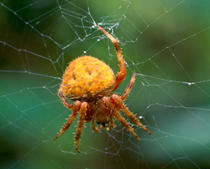
Fall is the time of year when we see many spiders at the park. Last week in the garden I came across this lovely spider enjoying her breakfast.  I decided to get to know this spider a little better.


                                                                   Marbled Orb Weaver                            Crab Spider
                                                               
                                                         Jumping Spider                                Arrowhead Spider

My spider is one of more than 45,000 spider species in the world.  They can be found everywhere but the poles, oceans, and high mountains.


   Wolf Spider with eye shine
Photo credit Sullivan County Conservation District

Spiders are found both day and night. They are easy to find at night because their eyes shine when exposed to light light.  A fun activity is to look for spider eye shine after dark. Take your flashlight out and look for glowing green dots along the side of the trail, in bushes or on your darkened porch.  Those are spider eyes.


        Wolf Spider with Egg Sac

Only about fifty percent of the spider species spin webs.  Other spiders, such as this wolf spider, live in the ground, on plants, or under low growing bushes.  These spiders are excellent hunters.


Orb Web

The spider in the garden is a yellow garden spider.  Argiope aurantia.  It is one of 4000 species of orb weavers.


Yellow Garden Spider

This species of spider, like all spiders, has eight legs, a cephalothorax, abdomen, fangs, and a silk spinner.  Unlike other spiders, this species has a unique third claw on each leg to help spin complex webs.  Spiders have from zero to eight eyes.  My garden spider has eight.


Marbled Orb Weaver Spinning a Web
Photo Credit Kim Bailey

A typical orb web spider builds a web between two very strong supports.  Two types of silk are used.  The first, a non-sticky silk, creates the radial threads of the web.  The frame of the web is made by the same silk   The other spiral threads are made of a sticky silk, which is clingy.  Most orb spiders eat and rebuild at least part of their web every day or night.  On average it takes 30 to 60 minutes for this spider to spin its web.  A yellow garden spider uses her web for a few days.


Yellow Garden Spiders on her Web

The web is almost like an extension of their bodies, used to catch meals and increase their awareness of the world around them. Orb spiders have very poor eyesight, but they don’t need to see well because of the way they use their webs. There are special lines in their webs to sense prey. When something touches these lines, the lines vibrate, and the vibrations are a message to the spider, telling it there is something in the web. The spider can tell by the way the web vibrates if the movements a struggling insect victim, or something else. 


Writing Spider

Notice the zigzag in the middle of the web. The “zipper” or “zigzag” in question is called the ‘stabilimentum”.   Scientists are not sure why the spiders spin these structures.  One theory is it provides stability to the web.  Another theory is it attracts insects by reflecting UV light.  A third is it warns birds not to fly through the web, thereby preserving the web. Scientist are studying the webs to find the answer. The zigzag has also earned this spider the nickname Writing Spider.


  Yellow Garden Spider Catching Prey                  Yellow Garden Spider Eating Prey


Yellow Garden Spider Wrapping  Prey

 
As stated the web is used to catch prey.  The orb spider prepares its trap b
y putting sticky drops on a thread in the web, and then “plucking” the thread (like a string of a guitar) with a leg. This spreads the sticky drops along the silk lines of the web. When it catches an insect, an orb spider uses its front legs to quickly spin the insect as it uses its back legs to pull out silk, wrapping the victim like a mummy.  Because the spider liquifies the prey with enzymes, the spider can wait several hours to days before eating it.


Check out this video of a yellow garden spider and her mate.
 
Want to know a little more?  Check out our TikTok.


Orb web with spider at night

These amazing creatures are all around us.  Take some time to explore spiders and discover what amazing creatures they are.

Wednesday, August 3, 2022

What We Learned from Nature and the Naturalists: Summer Seasonals 2022

What We Learned from Nature and the Naturalists: Summer Seasonals 2022

By London Craddock


Working as a seasonal naturalist at the Warner Parks Nature Center over the last two summers has changed me. The slightly awkward, future-insecure kid I remember from a little over a year ago is now a more confident young adult and a committed environmentalist. My fellow seasonals have grown as well. Here’s what we learned.

Paige Range, a rising senior at Hillwood high school, feels far more comfortable in nature than when she started.

“If I was even 50 feet within a snake I’d want to leave […] and then the other day, when we were searching the river, one of the people came back and they were like ‘there’s a snake sitting on a rock,’ and I immediately got up and wanted to go see it,” she said.

Paige (front left) takes picture with seasonals before caving

This kind of curiosity and enthusiasm is consistently modeled by the full-time naturalists on staff, and it is essential to our effectiveness as facilitators of natural experiences.

“The biggest thing I learned,” Paige said, “was how to […] make really fun, interactive programs. […] If people are excited about nature, then they’ll keep coming back, and that’s how you can really stick the information in.”

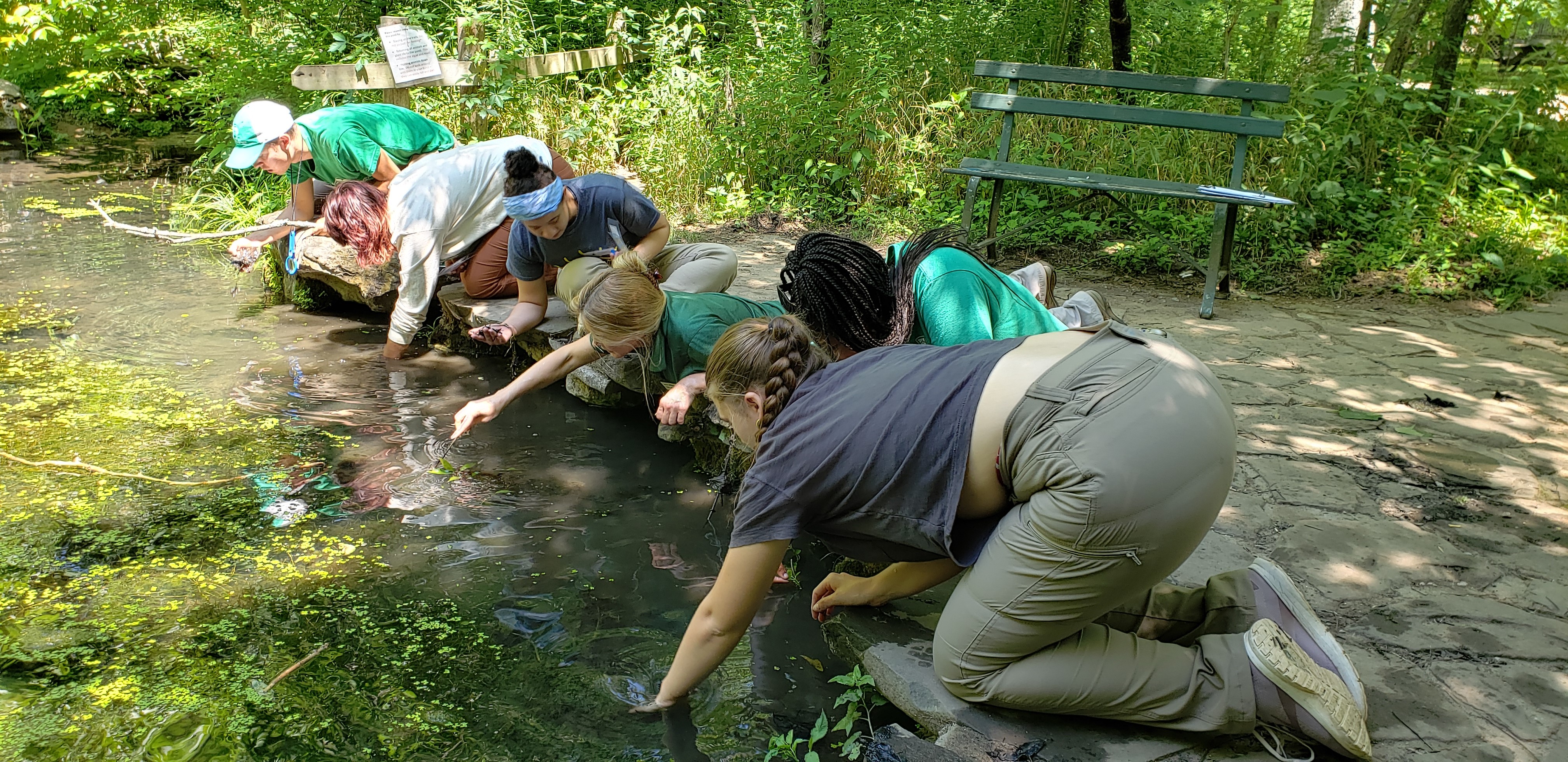
seasonals searching for animals at the pond

Gurnoor Majhail, a rising sophomore at Duke University, agrees with Paige, but they emphasize that this approach brings joy and fulfillment to their own life as well.

“Curiosity and wonder have been the big [values I’ve been focusing on] for this past year or so, and working here, I experience them every day,” said Gurnoor. “I love that we get to help other people experience such wonder […] outside and […] in nature. For example, at the beginning of the [PEN Pals] day, some of [the kids] are super into bugs and some of them are like ‘Ewww,’ and I think it’s so fun when, by the end of the day, they’re tapping on my shoulder and they’re like ‘Gurnoor, come look at this bug, it’s so cool!’ It’s just like that small pocket of happiness and joy that they find and that curiosity […] that maybe otherwise they wouldn’t have had. [It’s] such a gift to […] able to share that and to feel like I have an impact in a way that I want to.”

Gurnoor pointing out a bird to campers

Evidently, this job involves a great deal of interaction with the public and teamwork with fellow staff. Linnea Lyons, a rising senior at Belmont University, feels that her two summers here have increased her social confidence.

“Before I worked this job in college, I didn’t talk to people, I didn’t network,” she said. I feel like this job taught me how to communicate […] in a team setting and be more confident and open-minded around other people. Teamwork is so powerful and it’s really so efficient—that’s probably the biggest thing I learned.”

Gurnoor (left) and Linnea (right) admire the cave

I had a similar experience, as did Austin Anderson, a rising freshman at Eckerd College. However, he also appreciates that we were given opportunities to pursue individual projects and plan our own programs.

“I feel like my skills working with other people in general have grown,” Austin said. “The whole way that we have the seasonal program set up, where you work on your own thing for a while and then come back and work with others, was really great. […] It gave me an opportunity to work on both how I do things [independently and] how [I can] take what I’m good at and supplement what others are good at.”

Austin wheelbarrowing a dog

Even with abundant planning, unexpected challenges arise, and Bekah Truss, a rising senior at St. Louis University, says her experience here has taught her to embrace them.

“This summer and last summer, I’ve learned that it’s okay to not plan things all the way out, like when we had to plan [an] Explore with a Naturalist in like an hour,” she said. “That was a good experience because I wanted to think about it more, I wanted to have more time to plan it, but it turned out okay. And during the field trips, when [the groups] didn’t show up on time, and with PEN Pals—just being able to adapt and respond to things as they change […] is probably the biggest thing I’ve learned here.”

Bekah and London showing off a wood ear

It's safe to say that the nature of the work, the culture our bosses work hard to create, and the park itself have helped all of us grow. I want to extend my gratitude to all of the organisms of Warner Park (including the people!) for watering the soil of our budding adult selves this summer.

The seasonals presenting their hard work
The seasonals enjoying the nature center


Friday, June 24, 2022

Keeping Cool Sustainably


Keeping Cool Sustainably

Jessa Tremblay 


I’m not sure if you all have gone outside this week, but it is HOT! We are in the middle of a record setting heat wave right now in the country and our electrical systems are being put to the test. Our increased electrical usage is bad for our pocketbooks and is bad for the environment! So how can we take care of the planet while also making sure we are comfortable?


Quick easy solutions for the home:

1. Invest in some thick, light color shades for your windows. Any window that receives direct light lets in a lot of heat. The shades help insulate the windows keeping your room much cooler than if direct sunlight was able to penetrate.  You can increase the effectiveness of this if you have white or light colored curtains.

"Curtains in Ivory Linen with Coral Hem and Sheers" by DesignFolly.com is licensed under CC BY-SA 2.0.

2. Replace the filter on your AC unit. Your AC unit runs inefficiently if your filter is dirty! Making sure this is replaced regularly will help your system run better and use less electricity. This could reduce your energy consumption up to 15%.

"dirty filter" by ryeckman is licensed under CC BY-NC-SA 2.0.

3. Wash your laundry on cold then hang your clothes to dry. Both the washing machine and the dryer are creating heat when they run. This heat can then radiate into your house. Doing this will help keep your house cool and reduce your electricity consumption.

"Vintage line-drying" by Andrea_R is licensed under CC BY-NC-SA 2.0.

4. Avoid cooking inside using heat. Once again these appliances generate a lot of heat that needs to go somewhere and that somewhere is your house. Instead of cooking with your stove or oven try making something that requires no appliances like a salad! (Bonus points if you don’t use meat) If you do need to cook a warm meal, wait for the evening once temperatures start to cool or cook outside on a grill.


Cooling Investment solutions:

We just looked through some solutions that are simple and cheap to do, but what if you want to do something bigger? Due to climate change, temperatures like this are probably going to become more normal. You might want to consider investing in some bigger projects that can reduce your long-term energy consumption!

1. Plant trees. Planting trees in strategic places throughout your yard is a simple way to keep your house cool. Just think about when you take a walk through Warner Parks. You can feel just how much cooler it is once you are under the canopy. Planting trees near your home can block direct sunlight and will keep your house about 5 degrees cooler otherwise.


2. Insulate, insulate, insulate. Many houses do not have the proper amount of insulation and they have air leaks. This means you are using more energy to heat and cool your house because the warm and cool air escapes. Luckily there are tests you can perform on your house where you can find those air leaks and fix them!

More about sealing your home.

3. Replace your windows. Old single pane windows let in a lot of heat and are huge sources for air leaks. Newer double paned windows are insulated which means you’ll use less energy and feel more comfortable!

4. Install a geothermal heating and cooling system. Have you ever been inside of a cave in the middle of summer? Caves are remarkably cool because they are underground For example caves here in Tennessee usually hover around 60 degrees inside. Geothermal heating and cooling systems tap into this idea and use the ground to heat and cool your home.


7. Use solar panels creatively. Not only can you generate energy by installing solar panels, you can create shade! Use solar panels to shade a carport, a back porch or even over a pool.

There are many different ways we can beat the heat sustainably. It’s important now more than ever that we start to implement thing like these ideas into our every day life. It’s only going to get hotter and we need to find new solutions to use less electricity.       

Spring Cleaning--Preparing Your Yard for the Birds

Written by Jenna Atma, Avian Biologist and Naturalist All photos taken by Jenna Atma Spring is just around the corner, and with the weathe...