Shared by Melissa Donahue
Naturalist
melissa.donahue@nashville.gov
Photos courtesy Melissa Donahue unless otherwise noted
I’ve been away for a while. Happy family obligations at the first of the summer pulled me away from Nashville and I’m just getting back to Warner Parks. I feel a bit out of sync. Missed seeing the first tiger swallowtail, tasting a ripened blackberry and hearing the first cicada call. To reconnect with the season and the Parks I hiked around Butler Field. Will Chamberlain, a co-worker and wildflower enthusiast, was kind enough to join me. We met on a foggy morning in August.

One of the first flowers we observed was Fogfruit - Phryma lanceloata. This herbaceous perennial plant is ½–2' tall. It’s a small plant but once you notice it, it seems to be everywhere. Many different pollinators are attracted to the flower. The largest group of pollinators are a small to medium size flies which hover motionless in the air.

Fogfruit in bloom in Butler Field
We also noticed this pretty little Virginia buttonweed – Diodia virginiana-- at the edge of the field. A native flower, it grows low and mats close to the ground. Do not plant it in your garden, as it is quite invasive.

Virginia buttonweed in Butler Field
Although this plant is better known for the frost flower seen in November, it produces white flowers in August. Known as White wing-stem, crownbeard, or frostweed, Verbesina virginica, it stands 3 – 7 feet with winged stems. A native species, the little white flowers attract honeybees, butterflies and migrating monarchs. Frost flowers form around the first frost. These flowers are formed around the stem and just above the ground during cold autumn nights. This is caused when water is forced out of the stem during the first hard freeze resulting in ice formations.

Frostweed in bloom in early August in Butler Field

Frostweed/"frost flower" in November
Passionflower vines, Passiflora incanata, were also blooming. This is the state wildflower of Tennessee. Once used to treat anxiety, it the host plant of the Gulf and Variegated Fritillary butterflies and nectaring plant for many other butterflies. The seed pod gives the plant its other name, Maypop. This seed pod may pop when opened, revealing delicious seeds and giving this plant the name Maypop.
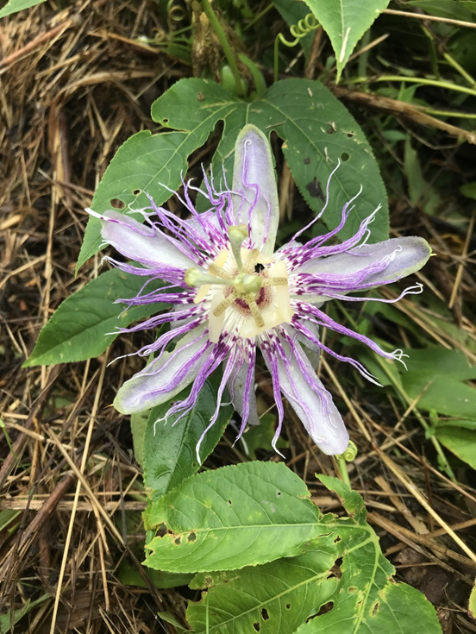
Passionflower or Maypop in Butler Field
Brown Eyed Susan – Rudbeckia triloba – is a Tennessee native of the sunflower family. These plants bloom from mid to late summer. Although self-pollinating, the flowers attract bees, wasps, small butterflies and other insects. It is a traditional Native American medicinal herb used by several tribal nations, believed to remedy colds, flu, infections and snake bites, among other things.

Brown-eyed Susan in Butler Field
Towering above our heads was the Ironweed – Vernonia Gigantea, a member of the Aster family which grows 3-10 feet tall. This showy native is a host plant for several moth species.Native Americans used the leaves and roots to make a tea used during pregnancy, childbirth and to relieve postpartum pain.

Tall Ironweed in Butler Field

Finally, the plants most of us are very aware of this time of year: Great Ragweed, Ambrosia trifida and Common Ragweed, Ambrosia artemisiifolia are coming in strong! Common Ragweed grows 1-4 feet tall and Great Ragweed grows 3-12 feet tall. Although known for causing hay fever, this plant has other uses. Native Americans cultivated Common Ragweed as a source of food before maize, using the stalks to manufacture ropes and the leaves to prevent bleeding. Common Ragweed effectively removes lead from the soil. The flowers of Great Ragweed can be crushed to make a red dye. Today it is a seed source for many birds.

Great Ragweed

To visit Butler Field, park near picnic shelter #9 in Edwin Warner Park. Head out for a stroll and let us know what you see.


