Wednesday, October 21, 2020

Moon-watching

 Moon-watching

Shared by Sandy Bivens

WPNC BIRD Program

sandy.bivens@nashville.gov


I am a moon-watcher and have been for as long as I can remember.  I like moon light, moon shadows, moon dancing, moon music, moon friends, moon stories, moon hikes – and full moon picking parties. 


Full Moon photo courtesy Theo Wellington

This year, October is an especially nice time to watch because it has two full moons.  Today a common definition of a blue moon is the second full moon in a calendar month.  On 1 October there was a full moon and now coming up on 31 October there will be another – a blue moon!  The moon does not actually appear blue (but sometimes the moon might look blue due to dust storms, forest fires, or volcanoes) – but was named so because it is uncommon (occurring every 2-3 years).


Moon in my yard

Campfire in my yard

October is always a great month to watch the moon – the air is crisp, it is getting dark earlier, fewer rainy days and more clear skies for viewing, and maybe you can have a campfire to keep you warm. 

I like to watch the phases of the moon as it rotates and revolves once around Earth each month as we make our annual journey together around the Sun.  I like full moons, new moons, tiny crescent moons (and even a crescent moon vase filled with buckeyes) and who doesn’t like to say, “waxing gibbous”.  And it is comforting to watch the apparent changes of the moon yet know that it always comes back to full again. And the cycle continues.


Crescent Moon Vase with Buckeyes


My Moon Journal


Take a walk around the phases of the Moon at the Nature Center!

             
Cloudy Moon by Kim Bailey


The moon and its ever-changing cycles have been used to track time by many cultures. The word “month” comes from “moon”.  In the past, the definition of a month was the time between one new moon to the next.  And there are usually 12 moons (months) each year.  Even the days of the week are named for objects in the sky.  Which day do you think is named for the moon? Or the Sun?


Turtle shell with 13 sections

Some Native American cultures tracked time by 13 moons in a year.  A turtle’s shell has 13 sections and was sometimes used to document the annual cycle. Each moon was named for what was happening in the natural world.  October was “Hunter's Moon”, Harvest Moon, Migration Moon or Falling Leaves Moon depending on the tribe and region.  What name would you give this October moon?


Full Moon over water by Kim Bailey

Another thing about moon-watching is you can do it anywhere!  Inside your house or in the backyard; in the city or in the country, at the beach or on a mountain.  At night or in the daytime! And you don’t need anything to watch – although it can be fun to see it with binoculars or a telescope sometimes.  


      Full Moon by Kim Bailey

So, I hope you step outside and enjoy a little moonshine from the Blue Moon on 31 October – and some moon-watching all year long.  I am going to celebrate the moon and try to do a “moon zoom” with my sisters – they are moon-watchers too. The next Blue Moon will be here on 31 August 2023 – and we should all be able to plan on celebrating with family and friends under the moonlight together then.

For more Moon information:

 skyandtelescope.org

Sudekum Planetarium at Adventure Science Center

Thirteen Moons on Turtles Back:  A Native American Year of Moons, by Joseph Bruchac and Jonathan London


Friday, October 2, 2020

Into the Woods

Into the Woods

Shared by Betty Krogman

Urban Naturalist

betty.krogman@nashville.gov

Photos courtesy Betty Krogman

My work is in city neighborhoods so for relaxation, I head to the country.

Country roads that lead to wild spaces refresh my soul. And so it was on a glorious Saturday morning that I hiked the Bicentennial Trail in Ashland City.

Few people were on the trail as it was early, and Fall wildflowers were in bloom. I took many pictures to post on  iNaturalist for verification and to add to research. That’s a fun tool.


Yellow coneflowers blooming in the Master Gardener's bed. 


The American Beautyberry was in glorious color. 

Birds were also singing, and I have learned some of their calls, but the sheer delight of a cacophony of natural sounds needed no identification, really. To have a totally quiet space to hear them was enough.


While listening to the birds, I noticed a Scarlet Waxy Cap mushroom. 

My outstanding experience that day, however, was sitting on a rock in a creek, listening to trickles of water, while watching a Red Spotted Purple butterfly dance and flit in the glistening sun. Bliss!


Friday, September 11, 2020

Some Things Never Change, Even in 2020

Some Things Never Change, Even in 2020
Shared by Heather Gallagher
Naturalist
heather.gallagher@nashville.gov
Photos courtesy Heather Gallagher

During typical times, when we hike freely throughout the Parks, enjoy the Museum and porches without masks, and host school children from all over middle Tennessee, I learn new things every day. Perhaps it’s a new insect on the tomatoes in the garden, or a wildflower on the trail that I’ve never seen before.


I discovered cicadas mating on a tomato plant. 

Slender Ladies' Tresses orchid is blooming right now in Warner Park. 

2020, though, has brought a whole new learning curve. Who would’ve thought 6 months ago that we would be offering hummingbird programs via Zoom webinar? Who would’ve guessed that all of our fall programs would be offered virtually?

And yet, even with these changes, some things remain the same:

The goldenrod still blooms this year in the fields.


Goldenrod is blooming in the Meadow next to the Nature Center. Although many folks believe it causes allergies, goldenrod is actually pollinated by insects not wind. 

The Monarch butterflies are still munching on milkweed and migrating.


Monarch butterflies lay eggs on milkweed plants like these in the Organic Garden. The caterpillar will eat leaves of the host plant, then spin a chrysalis, changing from egg to butterfly in a matter of weeks. 

The organic garden is overflowing with Kentucky Wonder beans and Kellogg’s tomatoes.


2020 has been a great garden year: the yellow Kellogg's tomatoes and Kentucky Wonder (as well as our Chinese Long and Rattlesnake) beans have been quite productive. 

And the Black Gum leaves are starting to turn a brilliant red, just like they do every autumn.


Black Gum leaves are among the first to change in early September. 

What signs of fall have you noticed so far this year? May I suggest documenting them—you don’t have to use a journal; a calendar will do just fine. When do the maple leaves start to turn? When do the black walnuts first begin to fall? When do the cicadas sing their last song of 2020?

Compare your calendars year after year, and you’ll begin to notice patterns in seasonal changes. From this, I hope that you gain a sense of stability, that even when the world around us is full of change, nature is resilient. 


Tuesday, August 18, 2020

Butler Field Beauties

Shared by Melissa Donahue

Naturalist

melissa.donahue@nashville.gov 

Photos courtesy Melissa Donahue unless otherwise noted


I’ve been away for a while.  Happy family obligations at the first of the summer pulled me away from Nashville and I’m just getting back to Warner Parks.  I feel a bit out of sync.  Missed seeing the first tiger swallowtail, tasting a ripened blackberry and hearing the first cicada call.  To reconnect with the season and the Parks I hiked around Butler Field.  Will Chamberlain, a co-worker and wildflower enthusiast, was kind enough to join me.  We met on a foggy morning in August.


One of the first flowers we observed was Fogfruit - Phryma lanceloata.  This herbaceous perennial plant is ½–2' tall.  It’s a small plant but once you notice it, it seems to be everywhere.  Many different pollinators are attracted to the flower. The largest group of pollinators are a small to medium size flies which hover motionless in the air.

Fogfruit in bloom in Butler Field

We also noticed this pretty little Virginia buttonweed – Diodia virginiana-- at the edge of the field.  A native flower, it grows low and mats close to the ground.  Do not plant it in your garden, as it is quite invasive.

Virginia buttonweed in Butler Field

Although this plant is better known for the frost flower seen in November, it produces white flowers in August.  Known as White wing-stem, crownbeard, or frostweed, Verbesina virginica, it stands 3 – 7 feet with winged stems.  A native species, the little white flowers attract honeybees, butterflies and migrating monarchs.  Frost flowers form around the first frost. These flowers are formed around the stem and just above the ground during cold autumn nights.  This is caused when water is forced out of the stem during the first hard freeze resulting in ice formations.  

Frostweed in bloom in early August in Butler Field

Frostweed/"frost flower" in November

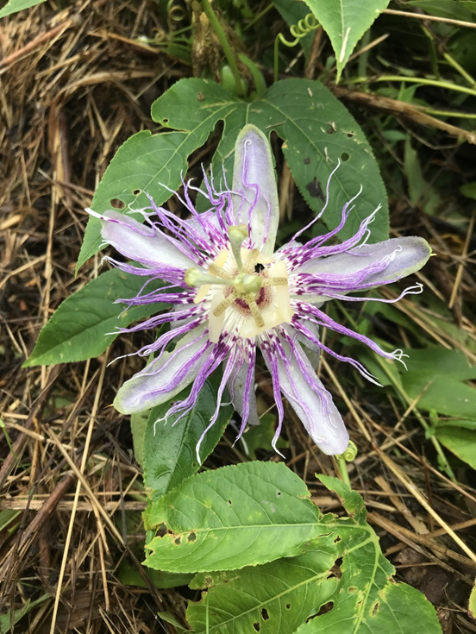
Passionflower vines, Passiflora incanata, were also blooming.  This is the state wildflower of Tennessee.  Once used to treat anxiety, it the host plant of the Gulf and Variegated Fritillary butterflies and nectaring plant for many other butterflies. The seed pod gives the plant its other name, Maypop.  This seed pod may pop when opened, revealing delicious seeds and giving this plant the name Maypop.

Passionflower or Maypop in Butler Field

Brown Eyed Susan – Rudbeckia triloba – is a Tennessee native of the sunflower family.  These plants bloom from mid to late summer. Although self-pollinating, the flowers attract bees, wasps, small butterflies and other insects.  It is a traditional Native American medicinal herb used by several tribal nations, believed to remedy colds, flu, infections and snake bites, among other things.

Brown-eyed Susan in Butler Field


Towering above our heads was the Ironweed – Vernonia Gigantea, a member of the Aster family which grows 3-10 feet tall. This showy native is a host plant for several moth species.Native Americans used the leaves and roots to make a tea used during pregnancy, childbirth and to relieve postpartum pain. 

Tall Ironweed in Butler Field


Ironweed is especially striking when a Swallowtail butterfly is drinking nectar from it. Photo credit Charlie Curry

Finally, the plants most of us are very aware of this time of year: Great Ragweed, Ambrosia trifida and Common Ragweed, Ambrosia artemisiifolia are coming in strong!  Common Ragweed grows 1-4 feet tall and Great Ragweed grows 3-12 feet tall.  Although known for causing hay fever, this plant has other uses.  Native Americans cultivated Common Ragweed as a source of food before maize, using the stalks to manufacture ropes and the leaves to prevent bleeding.  Common Ragweed effectively removes lead from the soil. The flowers of Great Ragweed can be crushed to make a red dye.  Today it is a seed source for many birds.

Great Ragweed

Common Ragweed


To visit Butler Field, park near picnic shelter #9 in Edwin Warner Park.  Head out for a stroll and let us know what you see.


Friday, August 7, 2020

No Holds BARS


No Holds BARS
Shared by Perri Haga

Warner Park Nature Center BIRD (Bird Information, Research and Data) Intern 
wpnc@nashville.gov
Photos courtesy of Laura Cook unless otherwise noted

My dad likes to say that if he ever wrote an autobiography, he’d call it “Mowing with Swallows,” because of the Barn Swallows (BARS) that love to swoop around him as his lawnmower stirs up insects for them to eat.  They’re fairly easy to spot in flight: just look for the characteristic forked tail silhouette and their graceful, swooping movements. 

Courtesy of Cornell Lab of Ornithology. If Barn Swallows were in the circus, they’d be acrobats for sure! 

Barn Swallows are a migratory species that spend their breeding season in North America during the summertime and head to Central and South America for the wintertime.  They nest in Warner Parks with the largest colonies at the Steeplechase barn and at the Nature Center. The next time you are at the Learning Center, turn your eyes upwards and you can see their nests made of mud on the sides of the building.

This nest is in the middle of a stall at the Steeplechase barn, and the babies are only a few days old!

Because of their choice of nesting location, some people don’t enjoy the presence of Barn Swallows, especially when nestlings start leaving huge messes behind… it can get gross!

However, I think that we should LOVE these birds! Not only are the adults majestic and the babies adorable, but they also are insectivores, providing us an amazing ecological service in the summertime by consuming incredible amounts of insects: around 34,000 insects per nestling!

Courtesy of Charlie Curry. Begging nestlings are a common sight at the Nature Center in the summer. You can hear them even before you can see them!

This summer, I was so excited to be the Warner Park Nature Center BIRD Program Research Intern through support from my college, Lipscomb University.  Because Barn Swallows are so reliant on man-made structures for their nests, depend on insects and are incredibly interconnected to us, they were a perfect species for me to study.  

How could you resist that little face!? This nestling is seven days old. His eyes and ears are open, and feathers are just about to emerge from the spines on his tail.  

This little guy wouldn’t stay away from his sibling!

There are three research techniques I used this year to get to know Barn Swallows better.  The first is when a federally permitted bander from the BIRD team places a lightweight numbered band on a nestling. Our hope is that one of these banded nestlings will be recaptured in South America and as they return to Nashville. This can help us learn about survivorship and migration. 

Before banding nestlings, we have to climb a ladder and bring everyone down in a basket.  These nests are high!

We use special pliers to put the band on so the nestling can’t even feel it. 

The second thing we do is assess survivorship from the time they hatch until they fledge (leave the nest). We do this by checking the nests regularly with a tool that looks like a suspiciously large dentist’s mirror! I do this three times a week to count eggs or nestlings, determine hatch dates, and track nestling growth. 

Using a mirror lets us see inside the tall nest without scaring the babies inside. 

The last aspect of my research is something that anyone can do: observation! I spend a lot of time watching the behavior of these birds, looking at how adults interact with each other, with their nestlings, with other birds, and more.  It’s fascinating how complex Barn Swallows are, and I discover new mysteries every day! 

Courtesy Charlie Curry. This bird hatched this nesting season. It has a paler face and hasn’t grown the long tail feathers typical of adults: a fun thing to observe! 

Most Barn Swallows will begin their migration south within the first couple weeks of August. 

 Keep an eye out for the last of these birds or look for the nests that they’ve left behind.  They’ll be back next spring and might even reuse these nests for a new year!


Tuesday, July 21, 2020

The Heart of Purple Martins

The Heart of Purple Martins
Shared by Heather Gallagher
Naturalist
heather.gallagher@nashville.gov
Photos courtesy Graham Gerdeman

As you have heard by now,  it has been a banner bird year at the Nature Center. The bluebirds, barn swallows and other insect eaters are visible and plentiful, especially if you choose to view them from the comfort of a rocking chair on the back porch.

And the martins-oh the purple martins! I have documented a minimum of 11 pairs and over 40 young at our site. But let's back up.

As a federally-licensed bird bander, I check our gourds weekly beginning in mid-May, each one yielding more nests, then more eggs, then more young.


Gourd with 6 beautiful eggs.


  • By May 27, I counted 32 eggs in 11 gourds. 
  • By June 2, there were 46 eggs. 
  • The next week eggs had begun to hatch, and I counted 29 young.  


Babies, probably around 2 days old.

Young martins display no feathers. They are all about food, and have large beaks to show for it. As they age, feathers will begin to develop in the form of pins that serve as protection for the feathers.  

Our study at the Nature Center is two-fold: we participate in the Purple Martin Conservation Association's Monitoring Project as well as the Purple Martin Banding Project through the BIRD program. Documentation of nests, eggs and young is reported to PMCA yearly, while the BIRD program info is submitted to the USGS Bird Banding Laboratory in Maryland

The emergence of pin feathers is an indication that the birds are at the age to be banded, around 16-20 days. Believe it or not, the band will not fit correctly until the baby martin's leg is SMALL enough for it. 

Due to the close proximity of the nests, I decided on one date to band all babies, choosing the date that babies would be in that 16-20 day old window. The gourd rack was lowered, and staff removed babies one nest at a time.

Babies ready to be banded!
 As Master Bander Laura Cook, our BIRD program coordinator, recorded band numbers, I banded each baby.

Pliers are specially adapted to securely and safely close bands.
The band can turn comfortably, just like my wedding band!

After applying bands to the left leg, Master Bird Bander Sandy Bivens returned nestlings to their proper gourds. When all birds are banded, we hoisted the gourd rack back into position, and the adults returned with food in less than a minute. 

This week has been extra interesting around the martin gourds, as a hawk has been checking out the fledglings taking their first flight. 

Hawks are one of the many predators that threaten martins.
Our martins will leave soon, gathering at a roost before heading to Central and South America. Yes--they leave Tennessee over the winter, returning next March to begin again.

Now the roost is most curious: in Nashville, Purple Martins will gather by the thousands--maybe even hundreds of thousands--in downtown Nashville around the river. So when my husband shared that Heart would be playing at Ascend last August, I jumped at the chance.

And I was rewarded! While everyone was jamming to Ann and Nancy Wilson, I was looking skyward, amazed at these incredible birds as they spiraled above the Cumberland. There must have been 30,000 martins!


Purple Martins have definitely stolen my Heart!


Friday, July 10, 2020

Creek Exploration 101


Creek Exploration 101
shared by Naturalist Rachel Anderson
rachel.anderson@nashville.gov
photos credit Rachel Anderson

With the warm, humid days here to stay for a while, it’s definitely a great time to head to a nearby creek to cool off and have fun.  For many, it’s enough to feel the cool water on your feet, let the kids splash and build dams, maybe watch a leaf boat float along lazily.

Boats made of all natural materials can be fun to float down the creek

But the naturalist in me suggests another exciting idea – look a little closer, delve a little deeper, and discover what other animals (besides humans!) can be found in the creek.

Most people have caught crayfish and there are certainly plenty of these in our creeks.  But have you really looked closely at one?  How many legs do they have? What color are the pinchers? What other body structures do you see? What behaviors do you notice when you place it back in the water? 

It’s best to pick up crayfish right behind their front pinchers like this.

And there are other invertebrates (animals without backbones) that live in the creek and are pretty easy to find.  Gently lift a small rock and look closely at the underside.  Do you notice anything moving?  What shape is it? 


How many legs does this little creature have? Do you see the 3-prong tail at the end?

Don’t worry about naming your discovery, instead focus on what you can observe, what questions you might have, and what your discovery reminds you of! 


This interesting creature reminds me of a worm or a grub. It moves like one – shrinking and growing – but it’s white all over with an interesting ring of tentacle-like structures at one end. I wonder if that is the mouth? Is this the adult form or a larvae? 


This round insect is a water penny. Finding these indicates good stream quality, as they can only live in clean water. 

There are so many tiny creatures under these rocks, you may want to bring a clear cup for temporary viewing. A white ice-cube tray also works well.  If you gently sweep your finger across the insect on the rock, you can lift it up, then dip your finger in the water to release it into your container.


Want to find more interesting creatures? Place a net in the water, downstream of a rock where the water is moving quickly. Lift the rock and anything under may float downstream into your net!  If you rub the underside of the rock while it’s still underwater, you can dislodge tiny creatures as well.


As you pick up rocks and use nets to search, be on the lookout for vertebrate animals as well, like salamanders and snakes.  Most snakes in our river are harmless and quickly move away when disturbed. 


What do you notice about this snake we found in the creek one day?  We learned these reptiles, called queen snakes, eat crayfish because it regurgitated its meal when we caught it.  Probably a good idea to leave them be in the future!


Found a 4-legged friend? Be sure your hands stay wet when handling these sensitive salamanders.


How many different animals can you find during your exploration?  What do you wonder about them? Be sure to take pictures and videos of the animals you find, and then carefully release everything back into its habitat.  And be sure to come by the Nature Center with your questions and we can help you learn more about your discoveries!


Spring Cleaning--Preparing Your Yard for the Birds

Written by Jenna Atma, Avian Biologist and Naturalist All photos taken by Jenna Atma Spring is just around the corner, and with the weathe...